
So I am loving the hell out of my Fly 10 moped. It was super easy to register here in North Carolina (story to follow), it’s relatively quick, and it’s pretty simple. Basically this is just a scooter from China rebranded. I’ve actually found a couple of things that seem to be custom, but not in a great way. But, when all is said and done, I’m pretty happy with the purchase.
One of the things that any electric vehicle owner is going to face is range anxiety. I’ve had that since I bought my first ebike. I had it when I bought my 2011 Leaf. I have it in my Chevy Bolt even though I’ve never come close to running out of juice. But that doesn’t mean I’m not going to have it with the Fly. Yes, my name is Steve and I suffer from range anxiety.
So how do we fix range anxiety? By leveraging the power of previous purchases and using my e-bike batteries to extend the range on the scooter!
This is a relatively straightforward concept. Take the nominally 48-volt batteries from my e-bike and run them through a DC-DC boost converter to get me the 70-volts necessary to charge the 17s lithium battery in my Fly.
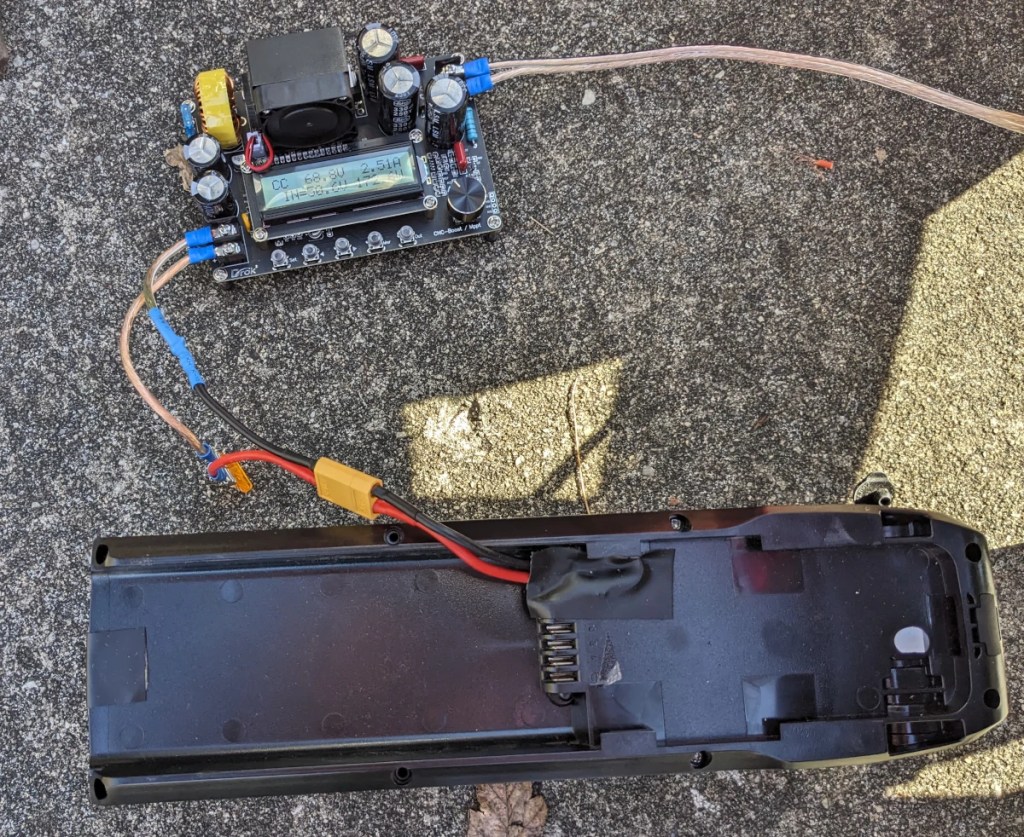
It’s a pretty simple concept. But I had a concern. If the bike battery is designed to dump a bunch of current into the motor system, what’s going to stop it from trying to dump 30 or 40 amps into the charge system?
I’ve used variable MPPT chargers to boost the various 24- and 26-volt chargers I had laying around to make custom 52-volt chargers to keep my e-bike battery at about 85%. (I read somewhere that this will extend life). But in those circuits it was the charger itself that limited the amperage. If it could only deliver 2 amps at 36v, then it wasn’t going to do more than about an amp at 52v.
What I needed was a variable boost converter that allowed you to vary not only the voltage like my MPPT controllers, but also the amperage.
Enter the DROX CNC-Boost with MPPT boost converter.
This puppy allows me to boost from 0-60v and output 1-120v at varying amperages. Overall this thing says it will do 800w at once. So some combination of volts at amps not to exceed 800w. To be on the safe side I’m keeping that below 200w.
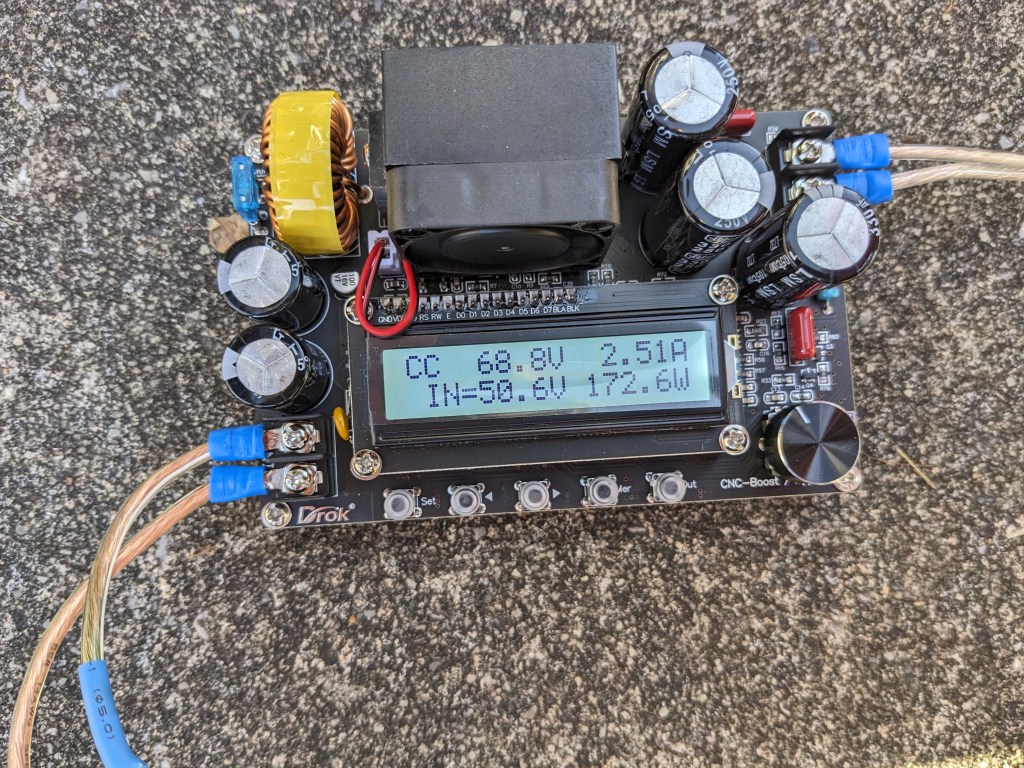
On initial tests the Drox had no trouble converting the e-bike battery voltage and stepping it up for 200w at 70v. It barely even turned the cooling fan on. Over the winter, I hope to ride it around more and see what kind of actual output we can get over a whole day.
Pros:
1. Gives extended range on the scooter.
2. Relatively inexpensive to set up so long as you have the bike batteries ($35 for the Drox, $12 for the protective project box).
3. Voltage independent – We can use this to charge our ebike batteries from drill batteries or car batteries… the options really are endless.
Cons:
1. Battery takes up space in the helmet/cargo box.
2. Requires a bit of splice work to get a parallel charging port.
3. Adds weight to the whole setup.
4. Not 100% efficient.
Thank you to Hilleater.ca for actually documenting using one bike battery to charge another on a ride. It took me way too much time on an enshittified Google to find someone who’d done this work.
 The HomeSpun Days
Leave a comment